
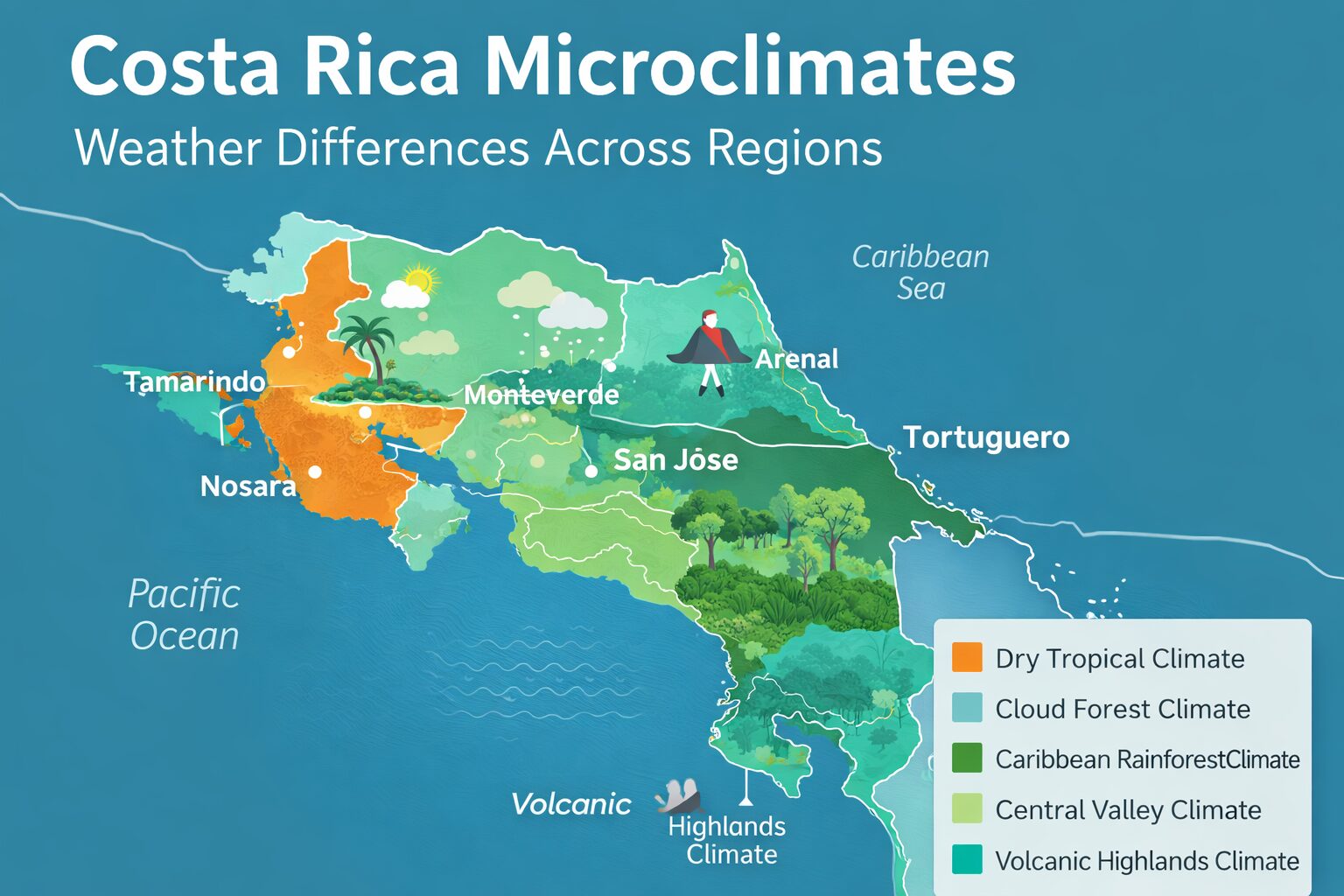
Costa Rica may be a small country, but its climate is surprisingly complex. Thanks to dramatic changes in elevation, proximity to two oceans, and dense tropical ecosystems, the country is home to dozens of microclimates.
In fact, you can leave a warm sunny beach in the morning, drive two hours into the mountains, and suddenly find yourself surrounded by cool misty cloud forest.
Understanding Costa Rica’s microclimates can help travelers choose the best destinations, pack correctly, and plan activities based on local weather conditions.
In this guide, we’ll explain why Costa Rica has so many microclimates, how they differ by region, and what you can expect when visiting different parts of the country.
What Are Microclimates?
A microclimate is a local atmospheric zone where the climate differs from the surrounding areas. These variations can be caused by:
- Elevation changes
- Mountains blocking weather systems
- Ocean currents
- Forest density
- Rain shadows
Costa Rica’s terrain includes mountain ranges, volcanoes, rainforests, dry forests, and coastal plains, all packed into an area smaller than West Virginia. Because of this unique geography, the country experiences dramatic weather variations within short distances.
Why Costa Rica Has So Many Microclimates
Several natural factors create Costa Rica’s diverse climate zones.
Mountain Ranges
The Central Mountain Range (Cordillera Central) runs through the country and includes famous volcanoes like Arenal, Poás, and Irazú.
Mountains act as barriers for weather systems, causing rain to fall on one side while leaving the other side dry. This phenomenon is known as the rain shadow effect.
Two Coastlines
Costa Rica is bordered by both the Pacific Ocean and the Caribbean Sea, each with different weather patterns.
- The Pacific Coast follows a typical dry and rainy season pattern.
- The Caribbean Coast receives rain more evenly throughout the year.
Elevation Changes
Elevation dramatically impacts temperature.
In Costa Rica, temperatures can vary by more than 20°F (11°C) depending on altitude.
Examples:
| Region | Elevation | Typical Temperature |
|---|---|---|
| Pacific beaches | Sea level | 85–95°F |
| Central Valley | ~3,000 ft | 70–80°F |
| Cloud forests | ~5,000 ft | 55–70°F |
Costa Rica’s Main Climate Zones
Although there are many variations, Costa Rica generally falls into several main climate zones.
The Dry Tropical Climate (Guanacaste)
Located in the northwest Pacific region, Guanacaste is the driest part of Costa Rica.
This region includes popular destinations such as:
- Tamarindo
- Playa Flamingo
- Playa Conchal
- Santa Teresa
- Nosara
Weather Characteristics
- Long dry season (December–April)
- Hot temperatures year-round
- Sparse tropical dry forest
During the dry season, landscapes turn golden and sunny skies dominate the region.
This makes Guanacaste one of the best places in Costa Rica for beach vacations and surfing during winter months.
The Central Valley Spring Climate
The Central Valley, home to San José, Alajuela, Heredia, and Cartago, has one of the most pleasant climates in the country.
Because of its elevation, the region experiences spring-like temperatures year-round.
Weather Characteristics
- Average temperatures: 68–80°F
- Cooler evenings
- Moderate rainfall in the rainy season
Many locals and expatriates consider the Central Valley to have one of the best climates in the world.
The Rainforest Climate (Caribbean Coast)
Costa Rica’s Caribbean region has a very different climate compared to the Pacific side.
Popular destinations include:
- Puerto Viejo
- Cahuita
- Tortuguero
Weather Characteristics
- High humidity
- Frequent rainfall
- Dense tropical rainforest
Interestingly, the Caribbean coast often has its driest months in September and October, when the Pacific side of the country experiences heavy rains.
This makes it an excellent alternative for travelers visiting Costa Rica during the fall.
The Cloud Forest Climate (Monteverde)
High-elevation regions like Monteverde create one of the most unique microclimates in the country.
Cloud forests form when moist air rises and condenses into persistent cloud cover.
Weather Characteristics
- Cool temperatures
- Frequent mist
- High biodiversity
- Constant humidity
Monteverde’s cloud forest is home to thousands of plant species, orchids, and rare wildlife, including the resplendent quetzal.
Because of the cooler temperatures, visitors should bring a light jacket or rain shell, even during warmer months.
The Volcanic Highlands Climate (Arenal & Highlands)
Regions around volcanoes such as Arenal, Poás, and Irazú have their own weather patterns influenced by elevation and geothermal activity.
In La Fortuna and Arenal:
- Mornings often start sunny
- Afternoon showers are common
- Rainfall supports lush rainforest
This climate is perfect for the waterfalls, hot springs, and wildlife that make Arenal one of Costa Rica’s most famous destinations.
Why Microclimates Matter for Travelers
Costa Rica’s microclimates mean that weather forecasts rarely apply to the whole country.
For example:
- It may rain in Monteverde while the beaches are sunny.
- The Caribbean coast may be dry while the Pacific experiences heavy rain.
- The Central Valley might have cool breezes while coastal areas feel tropical.
Because of this, experienced travelers often design itineraries that take advantage of different microclimates.
A typical itinerary might include:
- Volcanoes and rainforest in Arenal
- Cloud forest exploration in Monteverde
- Beach relaxation on the Pacific coast
This variety allows visitors to experience multiple ecosystems and climates in one trip.
Best Time to Visit Costa Rica (Considering Microclimates)
The “best time” to visit depends largely on where you plan to go.
Pacific Coast
Best weather: December to April
Caribbean Coast
Best weather: September to October
Central Valley
Comfortable weather year-round
Cloud Forest Regions
Cool and misty most of the year
Because of Costa Rica’s diverse microclimates, there is always a region with great weather somewhere in the country.
Experience Costa Rica’s Climate Diversity
One of the most fascinating aspects of Costa Rica is how quickly landscapes and climates change. In a single week, travelers can experience:
- Tropical beaches
- Volcanoes and waterfalls
- Misty cloud forests
- Wildlife-filled rainforests
This incredible variety is exactly what makes Costa Rica one of the most biodiverse destinations on the planet.
Understanding the country’s microclimates helps travelers plan smarter itineraries, choose the right destinations, and fully enjoy everything Costa Rica has to offer.
If you’re planning a trip and want help designing an itinerary that takes advantage of Costa Rica’s unique climates, explore our travel resources or connect with our team for personalized recommendations.
Need help planning the perfect Costa Rica itinerary?
Let our team help you choose the best destinations based on weather, seasons, and experiences.
👉 Contact us to start planning